

Revenue Growth Management (RGM) has quickly become one of the most exciting career paths for finance professionals. As companies face rising costs, changing consumer behavior, and increased competitive pressure, they need people who can do more than analyze financial statements. They need professionals who can turn financial data into profitable business decisions.
That shift has elevated Revenue Growth Management from a niche commercial function to a strategic capability. Today, RGM professionals influence pricing, promotions, product assortment, customer profitability, and long-term growth strategies across entire organizations.
If you’re beginning your finance career, developing expertise in revenue growth can open doors to roles that combine analytics, strategy, and cross-functional leadership. The best part? You don’t need to start your career with “Revenue Growth Manager” on your business card to get there.
In this guide, you’ll learn what Revenue Growth Management is, why it’s growing, the skills employers value most, and practical steps you can take to build a successful career in this evolving field.
Key Takeaways
- Revenue Growth Management combines finance, analytics, marketing, and sales strategy to improve profitable growth.
- Demand for RGM professionals continues to rise as companies prioritize pricing optimization and margin improvement.
- Strong entry points include financial analyst, pricing analyst, commercial finance, business intelligence, and revenue analyst roles.
- Technical skills matter, but communication and commercial thinking are equally important.
- Building cross-functional experience early in your career can accelerate long-term advancement.
What Is Revenue Growth Management?
At its core, Revenue Growth Management is the practice of helping organizations maximize profitable revenue—not simply increasing sales.
Unlike traditional financial planning and analysis (FP&A), which often focuses on budgeting, forecasting, and reporting, Revenue Growth Management examines the commercial decisions that influence both revenue and profitability. The goal isn’t just selling more products or services. It’s understanding which products, customers, channels, and pricing strategies create sustainable business growth.
Revenue Growth Management professionals regularly answer questions such as:
- Should prices increase for certain products?
- Which promotions actually improve profitability?
- Which customers generate the strongest long-term value?
- Are product bundles increasing revenue or reducing margins?
- How should demand forecasts influence pricing strategies?
These questions require collaboration across multiple departments. Finance teams work closely with sales, marketing, category management, supply chain, and executive leadership to balance customer expectations with financial performance.
For early-career professionals, this cross-functional exposure is one of RGM’s biggest advantages. Rather than working within a single finance discipline, you’ll gain visibility into how organizations make strategic business decisions.
Why Revenue Growth Management Is Growing
According to the Promotion Optimization Institute, “Revenue Growth Management is no longer limited to post-event analysis. Leading CPG companies are integrating RGM across five strategic levers: price strategy, promotion strategy, mix and assortment optimization, trade investment architecture, and portfolio strategy.” Additionally, several market trends have made Revenue Growth Management a strategic priority across industries:
1) Companies Are Under Pressure to Improve Margins
Inflation, supply chain disruptions, and rising operating costs have made profitability more challenging. Organizations are looking beyond cost-cutting initiatives and focusing on smarter revenue strategies instead. Rather than asking, “How do we sell more?” executives increasingly ask, “How do we grow profitably?” That subtle shift is exactly where Revenue Growth Management delivers value.
2) Data Is More Accessible Than Ever
Companies now have access to enormous amounts of customer, pricing, promotional, and transactional data. Modern analytics platforms allow finance professionals to identify patterns that were difficult—or impossible—to detect just a few years ago.
The challenge isn’t collecting more data. It’s turning that information into decisions that improve business performance. Professionals who can analyze data and explain what it means in practical business terms are becoming increasingly valuable.
3) Pricing Has Become a Competitive Advantage
Historically, pricing decisions were often reviewed once or twice each year. Today, many organizations evaluate pricing continuously based on customer behavior, competitive activity, inventory levels, and market conditions.
According to recent research from McKinsey & Company, organizations that develop mature pricing capabilities consistently outperform competitors in both revenue growth and profitability because they make more disciplined, data-informed commercial decisions. Revenue Growth Management teams play a central role in building those capabilities.
4) Finance Is Becoming More Strategic
The role of finance continues to evolve beyond reporting historical results. Modern finance professionals are expected to influence future business decisions, identify growth opportunities, and partner with operational leaders. Deloitte’s (2026) Consumer Products Industry Global Outlook highlights how finance organizations increasingly support commercial strategy through advanced analytics, forecasting, and pricing optimization rather than focusing solely on traditional accounting responsibilities. For professionals early in their careers, this evolution creates opportunities to develop business influence much earlier than previous generations of finance leaders.
5) AI Is Changing the Work—Not Replacing It
Artificial intelligence can identify pricing trends, forecast demand, and automate portions of data analysis. What it cannot replace is business judgment. Revenue Growth Management professionals still determine how analytical insights translate into pricing strategies, promotional investments, customer negotiations, and long-term growth plans. The professionals who combine technical skills with commercial thinking will remain highly valuable, even as AI continues to reshape finance functions.
Entry-Level Roles That Lead to Revenue Growth Management
One of the biggest misconceptions about Revenue Growth Management is that it’s an entry-level role. In reality, most professionals build relevant experience through adjacent positions before transitioning into RGM. Fortunately, there are several strong starting points for early-career finance professionals.
Financial Analyst
Financial analysts develop the core skills every RGM professional needs, including budgeting, forecasting, variance analysis, and financial modeling. While these roles are often internally focused, they provide an excellent understanding of how business decisions affect financial performance. Look for opportunities to work on pricing initiatives, product profitability, or commercial forecasting whenever possible.
Pricing Analyst
If your goal is a long-term revenue management career, pricing analysis is one of the most direct paths. Pricing analysts evaluate competitor pricing, customer demand, cost changes, and market conditions to recommend pricing strategies that improve both sales and profitability. You’ll also gain valuable experience measuring price elasticity and understanding customer purchasing behavior.
Commercial Finance Analyst
Commercial finance teams serve as strategic partners to sales and marketing organizations. Rather than focusing solely on reporting results, they help evaluate promotional effectiveness, customer profitability, and revenue opportunities. Because of this cross-functional exposure, many Revenue Growth Management professionals come from commercial finance backgrounds.
Revenue Analyst
Revenue analysts monitor sales performance, identify trends, and improve forecasting accuracy. These positions often provide experience working with large datasets while helping business leaders understand where growth opportunities exist.
Business Intelligence or Data Analyst
Today’s RGM teams rely heavily on analytics and visualization tools to support decision-making. Professionals with experience building dashboards, automating reports, and transforming complex data into actionable insights are increasingly valuable, even if they haven’t worked in a formal finance role.
Skills Employers Look For
Technical expertise will help you get noticed. Business skills will help you advance. The strongest Revenue Growth Management professionals combine analytical rigor with commercial awareness and communication skills.
Technical Skills
Focus on developing proficiency in:
- Advanced Microsoft Excel
- Financial modeling
- Forecasting and demand planning
- Power BI or Tableau
- SQL
- Data visualization
- Scenario and sensitivity analysis
Don’t worry if you aren’t an expert in every tool immediately. Employers are often more interested in seeing continuous learning and practical application than checking every box on a job description.
Business Skills
Equally important are the skills that help you influence decisions. Successful RGM professionals know how to:
- Present analytical findings clearly.
- Translate data into business recommendations.
- Build relationships across departments.
- Understand customer and market dynamics.
- Balance short-term performance with long-term growth.
- Communicate with both technical and non-technical audiences.
Remember, your analysis only creates value if decision-makers understand and act on it.
Build Experience Before You Have the Title
You don’t need “Revenue Growth Management” on your resume to begin building relevant experience. Start by volunteering for projects that expose you to commercial decision-making. For example, you might:
- Evaluate promotional performance.
- Support pricing analysis.
- Build sales dashboards.
- Improve forecasting models.
- Analyze customer profitability.
- Assist with annual planning.
- Present insights to business stakeholders.
These experiences demonstrate commercial thinking, which is often more valuable than having a specific job title.
Outside of work, consider earning certifications in Power BI, Tableau, SQL, or data analytics. You can also strengthen your portfolio by analyzing publicly available retail or consumer products datasets and presenting your recommendations as case studies. Hiring managers appreciate candidates who show initiative and curiosity beyond their day-to-day responsibilities.
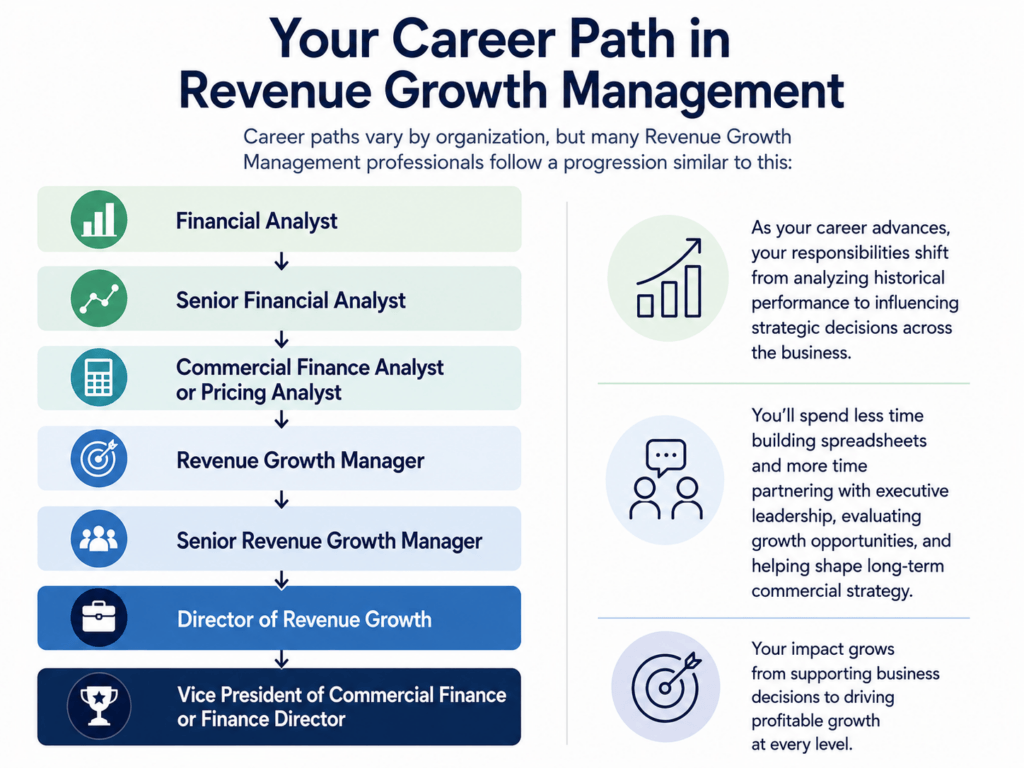
As your career advances, your responsibilities shift from analyzing historical performance to influencing strategic decisions across the business. You’ll spend less time building spreadsheets and more time partnering with executive leadership, evaluating growth opportunities, and helping shape long-term commercial strategy.
Common Pitfalls
Building a successful Revenue Growth Management career isn’t just about developing new skills. It’s also about avoiding habits that can slow your growth.
- Staying Too Focused on Finance: Strong RGM professionals understand how finance supports sales, marketing, operations, and customer strategy. Spend time learning how each function contributes to profitable growth.
- Waiting for the Perfect Job Title: Don’t wait until an organization posts a Revenue Growth Management opening. Relevant experience gained through pricing, forecasting, commercial finance, or analytics projects can position you just as well for future opportunities.
- Ignoring Communication Skills: Early-career professionals sometimes assume technical expertise alone will drive promotions. In reality, leaders value professionals who can explain complex analyses clearly and influence business decisions with confidence.
- Avoiding Technology: Analytics tools continue to evolve rapidly. Whether your organization uses Power BI, Tableau, SQL, Python, or AI-powered analytics platforms, developing technical fluency will help you remain competitive throughout your career.
Final Thoughts
Few professionals graduate knowing they’ll build a career in Revenue Growth Management. Most arrive there by saying yes to projects that expand their analytical skills, expose them to commercial strategy, and strengthen their understanding of how businesses create profitable growth. If you’re early in your finance career, don’t focus exclusively on finding the perfect job title. Focus on building the experiences that make you valuable—analyzing data, understanding customer behavior, communicating insights, and collaborating across teams.
Those capabilities will serve you well whether your next opportunity is in pricing, commercial finance, business intelligence, or Revenue Growth Management. As organizations continue investing in data-driven decision-making, professionals who combine financial expertise with commercial thinking will be well positioned for long-term success.
FAQs
Yes. While Revenue Growth Management often works closely with sales and marketing, many organizations position RGM within finance because of its emphasis on profitability, forecasting, pricing, and commercial analysis.
While both functions rely on financial analysis and forecasting, FP&A primarily focuses on budgeting, financial planning, and reporting. Revenue Growth Management takes a more commercial approach by helping organizations optimize pricing, promotions, product mix, and customer profitability to drive sustainable growth.
Finance, accounting, economics, business analytics, statistics, and mathematics all provide excellent foundations. Employers often value practical analytical experience just as much as your academic background.
No. While an MBA may be beneficial for some leadership roles, it isn’t a prerequisite for most Revenue Growth Management positions. Many professionals enter the field with a bachelor’s degree in finance, accounting, economics, business analytics, or a related discipline and build expertise through hands-on experience in pricing, forecasting, commercial finance, or data analytics.
For professionals who enjoy solving business problems with data, Revenue Growth Management offers strong long-term career potential. It provides exposure to executive decision-making, commercial strategy, and cross-functional leadership earlier than many traditional finance paths.
Yes. Many Revenue Growth Management professionals begin their careers in FP&A, commercial finance, pricing, sales finance, or business analytics. Experience analyzing financial performance, forecasting demand, or partnering with business teams can provide a strong foundation for transitioning into an RGM role.
Consumer packaged goods, retail, manufacturing, healthcare, food and beverage, technology, and eCommerce organizations all invest in Revenue Growth Management capabilities. As pricing and profitability become more strategic, demand for RGM talent continues to expand across industries.
Revenue Growth Management is most common in industries with complex pricing and promotional strategies, including consumer packaged goods (CPG), retail, food and beverage, manufacturing, and healthcare. However, more organizations across technology, eCommerce, and business services are adopting RGM principles as they focus on profitable growth.