

If you’re a tenured digital marketing professional, stepping into a marketing leadership position requires more than expertise in a specific channel or discipline. It means connecting marketing decisions to business outcomes, influencing cross-functional teams, developing others and making strategic decisions with greater accountability. Below are eight practical ways experienced you can prepare for a marketing leadership role and position yourself for long-term career growth!
Key Takeaways
- Connect channel performance to broader business results.
- Translate marketing metrics into language other executives understand.
- Build influence beyond your immediate team.
- Make informed decisions when the data is incomplete.
- Use AI and emerging technology strategically.
- Develop people, not just campaigns.
- Demonstrate leadership before you have the title.
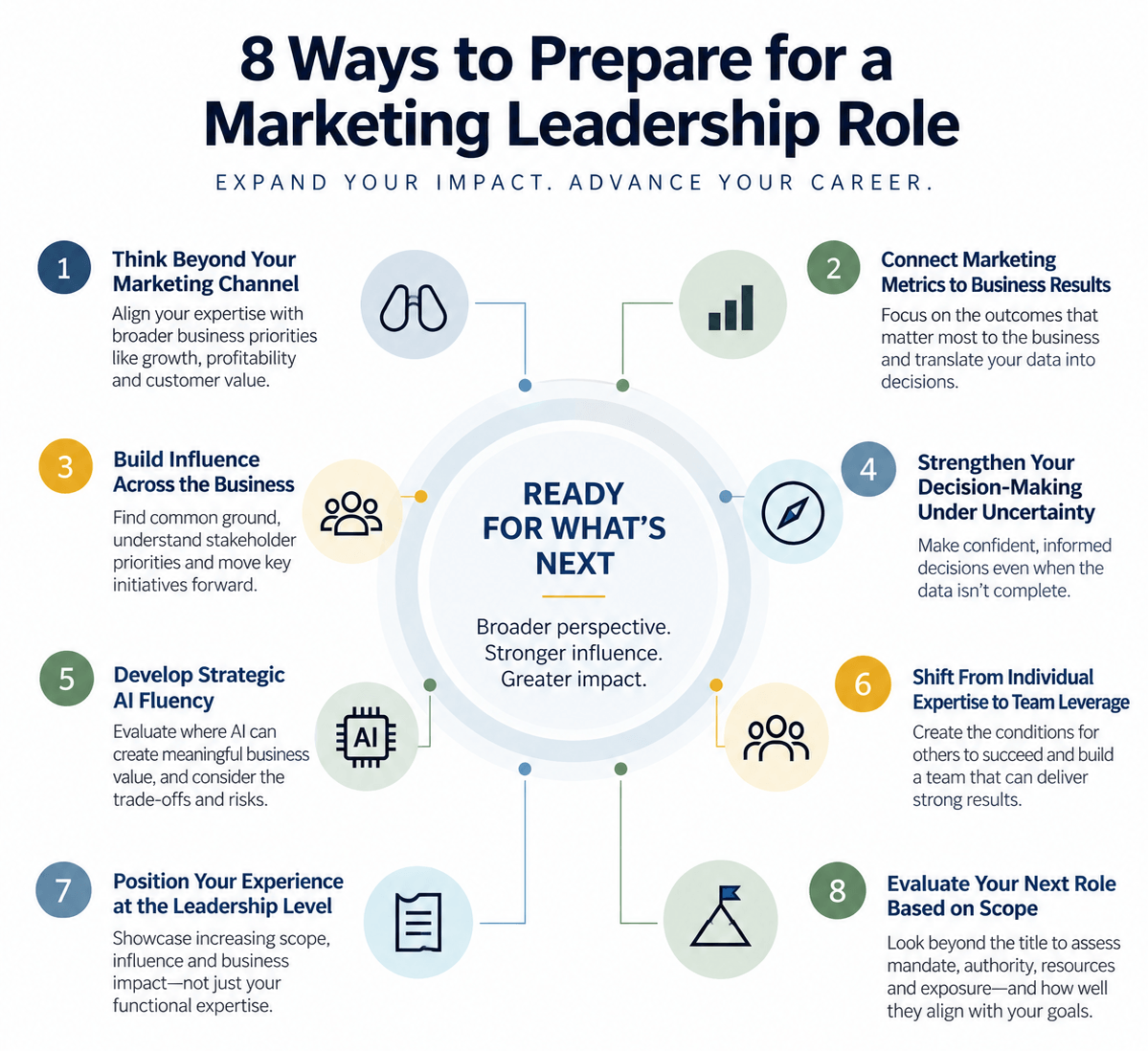
1. Think Beyond The Channel
Demonstrating functional expertise can help establish credibility. At the leadership level, however, the question becomes how effectively can that expertise be translated to broader business priorities. It requires looking beyond the performance of an individual channel. Customer acquisition, retention, revenue growth, margin pressure and changing customer behavior can all influence where marketing resources should go. The strongest-performing channel may not always represent the strongest investment for the business.
This broader perspective is becoming increasingly important. For instance, in its 2025 research, The CMO Survey reports that marketing leaders are assuming greater responsibility for areas such as revenue growth and customer insights. Developing new perspective doesn’t require becoming an expert in every marketing discipline. However, it does require understanding how different functions contribute to growth and being willing to challenge how resources have historically been allocated.
Action Item: Review where your team is investing time and budget across channels. Identify one area where historical performance, organizational habit or channel ownership may be influencing investment more than current business priorities. Build the case for maintaining, reallocating or testing that investment.
2. Connect Marketing Metrics to Business Results
Experienced marketers rarely lack data. The harder challenge is determining which information matters to the business and translating it into decisions senior leaders can act on because attribution is rarely perfect. For example, sales cycles can obscure the relationship between marketing activity and revenue. Brand investments may take time to produce measurable returns. Even performance channels can look very different once margin, customer quality or lifetime value enters the equation.
Today’s marketing leaders need to make sense of complexities. Yet, the CMO Survey found that 64% of senior marketing leaders reported challenges demonstrating marketing’s impact on financial outcomes. Another 51.8% reported difficulty focusing data and analytics on the most important marketing problems. Moving into marketing leadership means becoming more selective about the story your data tells. Executives generally need the implication, the business impact and the decision—not every metric that contributed to your analysis.
Action Item: Review a recent performance report or executive update. Assess how much of it explains marketing activity versus business impact. Reframe the discussion around financial outcomes, strategic implications and the decisions leadership needs to make next.
3. Build Influence Across the Business
Marketing leadership increasingly happens across organizational boundaries. A sound strategy can stall when sales, finance, product, technology or operations are working toward different priorities. That makes influencing others an essential part of the role.
This is not simply about building relationships or increasing your visibility. Senior-level influence requires understanding what other functions are accountable for and where their incentives differ from yours. For instance, a finance leader may evaluate an investment through profitability and risk. Sales may prioritize near-term pipeline. Product may be focused on adoption or customer experience. Marketing leaders need to make their case in a way that acknowledges those competing priorities.
The challenge becomes more pronounced at senior levels. The CMO Survey found that marketing leaders reporting difficulty securing cross-functional support for new investments increased from 28% in 2024 to 34.6% in 2025. Effective influence means finding enough common ground to move an important initiative forward without assuming everyone will view the opportunity through a marketing lens.
Action Item: Identify a strategic initiative where marketing depends on another function to succeed. Map each stakeholder’s priorities, constraints and measures of success. Then identify where competing incentives could stall the initiative and address those issues before they become roadblocks.
4. Strengthen Your Decision-Making Under Uncertainty
Digital marketing has created an expectation that almost everything can be measured. Leadership quickly exposes the limitations of that assumption. Some of the decisions with the greatest consequences come with incomplete information. For example:
- Should you protect brand investment when quarterly revenue is under pressure?
- Increase spending on a proven channel or fund an emerging opportunity?
- Add specialized talent or invest in technology that could expand the capacity of the existing team?
There may be credible arguments on both sides. However, the leadership skill is not knowing the answer with certainty. It is determining which information is material, recognizing the assumptions behind your recommendation and understanding the consequences of being wrong. That also requires knowing when more analysis will improve the decision and when it will merely postpone accountability.
Action Item: For an upcoming high-impact decision, document what you know, what remains uncertain and which assumptions carry the greatest risk. Define what new information would cause you to change course. This creates a more disciplined decision process without waiting for certainty that may never arrive.
5. Develop Strategic AI Fluency
AI fluency is quickly becoming part of the marketing leadership mandate. The differentiator at senior levels, however, is not familiarity with the largest number of tools. It is knowing where the technology creates meaningful business value.
The American Marketing Association found that 43% of surveyed marketers expected generative AI skills to become more important over the following five years. The research also identified communication, innovation and adaptability as important human skills. For marketing leaders, AI decisions can extend well beyond productivity. They can affect operating models, staffing needs, agency relationships, customer experiences and the economics of how marketing work gets done.
They also introduce trade-offs. Faster content production has limited value if quality deteriorates. Greater automation may create efficiency while introducing governance, privacy or reputational risks. Leadership requires separating a compelling demonstration from a compelling business case.
Action Item: Evaluate one AI use case through a leadership lens. Consider its potential effect on cost, capacity, quality, speed and customer experience alongside governance and reputational risk. Determine whether the business case justifies broader adoption rather than evaluating the technology on novelty alone.
6. Shift From Individual Expertise to Team Leverage
Success as a specialist often comes from becoming the person who can solve the hardest problems. That same strength can become a constraint as your responsibilities expand. If every complex decision still depends on your direct involvement, your expertise may be limiting the capacity of the team.
Marketing leadership requires a different form of leverage. Your role increasingly involves creating clarity, developing judgment in others and building a team capable of producing strong outcomes without your involvement in every detail. That does not mean stepping away from your expertise. Senior leaders still need enough functional depth to challenge assumptions and recognize weak thinking. The difference is where they apply it. Instead of being the person with every answer, your value increasingly comes from improving the quality of decisions made across the team.
Action Item: Audit where your expertise has made you indispensable—and where that dependence may now limit the team. Identify a responsibility, decision or capability that should no longer rely primarily on you. Then create the context and accountability needed for someone else to own it successfully.
7. Position Your Experience at the Leadership Level
Your experience may already demonstrate leadership but employers will not necessarily make that connection for you. A resume dominated by platforms, campaigns and tactical accomplishments can unintentionally position an experienced marketer below the level at which they are capable of operating.
Leadership-level positioning should demonstrate increasing scope. Look for evidence across your career of:
- Decisions you influenced or owned
- Budgets and resources you allocated
- Cross-functional initiatives you led
- Teams or professionals you developed
- Organizational complexity you navigated
- Business problems you helped solve
- Financial or operational results you influenced
The distinction is subtle but important: Managing a paid media program demonstrates functional experience. Deciding how to allocate a multimillion-dollar acquisition budget across channels demonstrates a different level of responsibility. The same principle applies during interviews. Your examples should reveal how your judgment, influence and decisions affected outcomes—not simply prove that you know how marketing works.
Action Item Review your career narrative for evidence of increasing scope. Your strongest examples should show more than campaign results. Look for progression in budget responsibility, strategic influence, organizational complexity, team development and business impact.
8. Evaluate Your Next Role Based on Scope
A leadership title does not guarantee a leadership mandate. For instance, a marketing director at one organization may control significant resources, manage a sophisticated team and participate in enterprise planning. At another, the same title may come with ambitious targets but limited authority to make the decisions required to achieve them.
That distinction matters when choosing your next move. Evaluate prospective roles across four dimensions: (1) mandate, (2) authority, (3) resources, and (4) exposure. Ask yourself:
- What outcomes will I ultimately be accountable for?
- Which decisions will I have authority to make?
- Will the budget and team support the expectations of the role?
- Where will I depend on other functions to execute?
- How will success be measured?
- Which strategic conversations will I participate in?
- What access will I have to the executives shaping those priorities?
Pay particular attention to mismatches between accountability and authority. Being responsible for aggressive growth without influence over budget, talent or strategy can create a very different leadership opportunity than the title suggests. In some cases, a lateral move with greater strategic scope can do more for your leadership career than a promotion with limited authority.
Action Item: Assess prospective opportunities across mandate, authority, resources and exposure. Look for alignment between what the organization expects you to accomplish and the influence you will actually have to accomplish it.
Final Thoughts
Moving into marketing leadership is less about distancing yourself from your digital expertise and more about expanding how you apply it. The strongest candidates can demonstrate that progression before their title changes. They understand the commercial implications behind marketing performance. They can allocate resources across competing priorities, influence decisions outside their function and increase the effectiveness of the people around them.
As you consider your next move, focus on opportunities that increase the scope of the problems you can solve—not simply the seniority of the title. Then, make sure your resume reflects that progression. Rather than relying on responsibilities alone, use measurable results to demonstrate the scale and impact of your work. For more guidance, explore our resume best practices for adding metrics that matter and learn how to present your experience in a way that gives employers greater context around your contributions.
FAQs
There isn’t one standard path. You might progress from specialist to manager, director and eventually VP or CMO. You could also move through senior specialist or strategy roles first. Focus less on titles and more on gaining broader responsibility for strategy, budgets, teams and business outcomes.
No. An MBA can strengthen your knowledge of finance, strategy and business operations, but it isn’t a requirement for most marketing leadership roles. Relevant experience, measurable results and demonstrated leadership can be equally important. Consider additional education when it closes a specific skill gap rather than treating it as a prerequisite for advancement.
It depends on where you can gain meaningful leadership experience. An internal promotion can offer valuable institutional knowledge and established relationships. An external move may provide greater scope or faster advancement. Compare opportunities based on responsibilities, decision-making authority and growth potential rather than assuming one path is better.
Look beyond years of experience. You may be ready when colleagues regularly seek your judgment, you can explain marketing decisions in business terms and you’re comfortable taking accountability for outcomes beyond your individual work. Another signal is whether you can help others succeed without needing to control every detail.
Look closely at what you’ll actually own. Ask about team structure, reporting relationships, budget authority, strategic responsibilities and how success will be measured. You should also understand why the position is open and what the organization expects you to accomplish during your first six to 12 months. Those details often reveal more about the opportunity than the job title itself.