

Hiring a marketing executive often creates a deceptively simple question: Do you need a big-picture strategist or a hands-on operator? In reality, leaning too far in either direction can create problems. A brilliant strategy delivers little value if the organization cannot execute it. Meanwhile, flawless execution can keep teams busy without moving the business in the right direction.
For HR leaders and hiring managers, the challenge is identifying a marketing executive who can connect both sides of the equation. The strongest leaders understand customers, markets, and business priorities. They also know how to translate those insights into focused plans, accountable teams, and measurable results.
That balance has become increasingly important as the marketing function expands. Great marketing leadership is no longer defined by campaigns alone. Today’s executives must influence revenue, customer experience, technology, data, talent, and broader business strategy.
Key Takeaways
Hiring a great marketing executive requires looking beyond strategy or execution alone. The strongest leaders connect the two to deliver measurable business results. Key considerations include:
- Evaluating strategic judgment through real decisions and trade-offs
- Looking for evidence that strategy translated into clear operating plans
- Assessing how candidates allocate budgets, talent, and other resources
- Prioritizing business outcomes over marketing activity alone
- Matching the executive’s leadership strengths to your organization’s specific needs
Organizations that hire marketing executives who can turn market insights into strategic choices—and strategic choices into measurable results—are better positioned to adapt, grow, and get more value from their marketing investments.
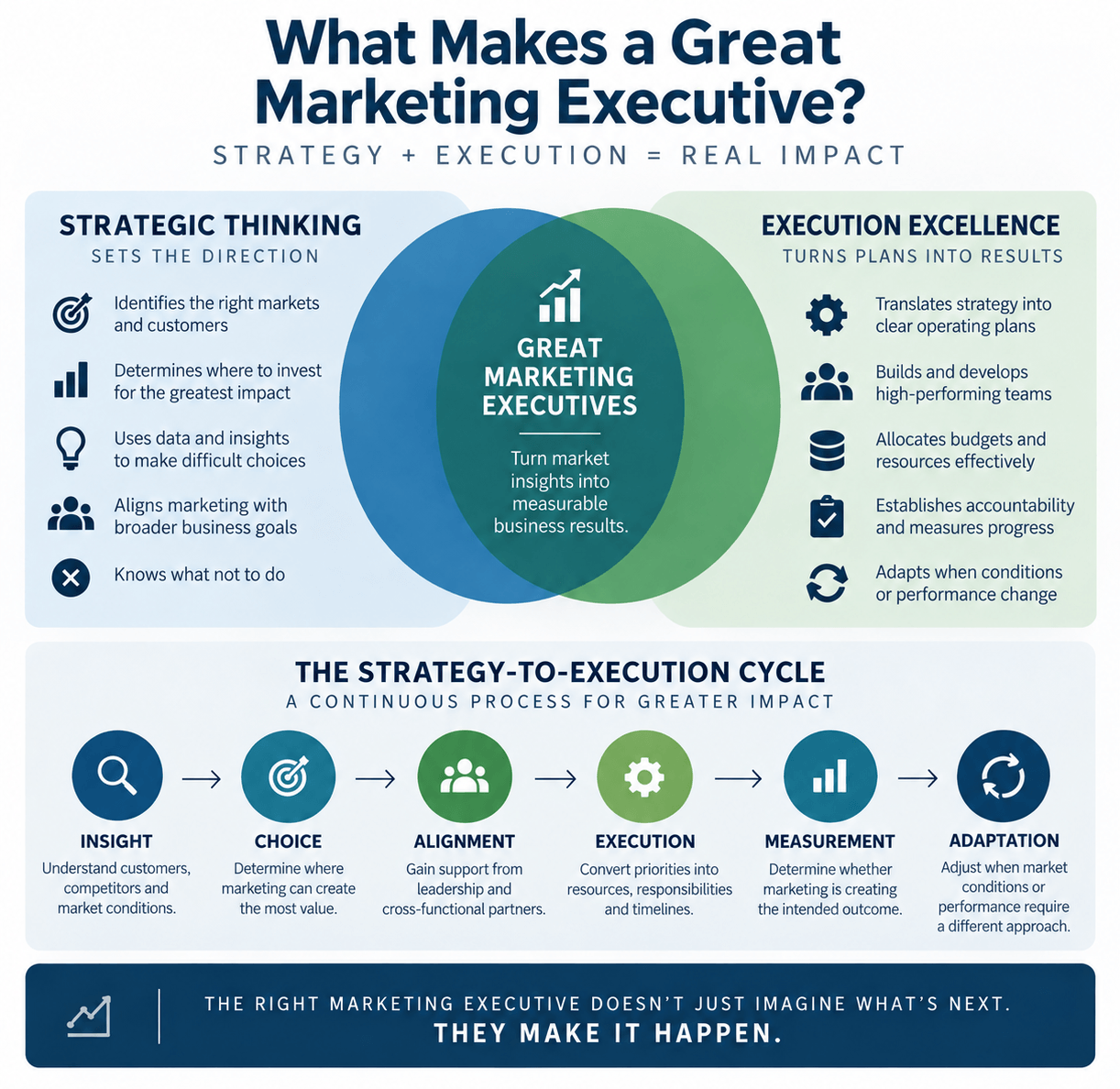
Strategic Thinking Starts With Making Decisions
Strategy is sometimes confused with vision. Vision matters, but effective marketing strategy requires something more difficult: Making the right decisions. A strong marketing executive should be able to determine:
- Which customers and markets deserve the most attention
- Where the company can create meaningful differentiation
- Which marketing investments support broader business objectives
- Which opportunities should not receive resources
- How customer and competitive insights should influence future priorities
That last point is particularly important. According to Gartner research, companies with “market-shaper” CMOs are 2.6 times more likely to exceed annual revenue and profit targets. These leaders do more than translate company objectives into marketing activities. They use customer and market knowledge to help shape the direction of the business.
When interviewing a marketing executive, listen for decisions rather than ideas. Ask what the candidate prioritized, what they chose not to pursue, and why. If every initiative was a priority, there probably was no real strategy.
Strategy Without Execution Creates Its Own Problems
Some marketing executives are exceptional at developing frameworks, presenting ideas, and communicating long-term vision. Problems emerge when you ask what happened next. A strategy-heavy candidate may struggle to explain:
- How the strategy became an operating plan
- How budgets changed to support new priorities
- Which capabilities the team needed to develop
- How responsibilities were assigned
- Which metrics determined success
- What changed when results missed expectations
This gap is common. Gartner found that 94% of CMOs say translating enterprise strategic directives into actionable marketing plans is challenging. The same research found that 84% of CMOs report high levels of strategic dysfunction, which Gartner defines as confusion and conflict caused by unclear, excessive, or competing enterprise objectives.
For employers, there is an important lesson here. Do not stop evaluating a candidate when the strategy sounds compelling. Ask them to show you what happened after the presentation ended.
Execution Means More Than “Getting Things Done”
At the executive level, execution does not mean personally building campaigns, writing copy, configuring platforms, or reviewing every deliverable. A great marketing executive creates the conditions that allow other people to execute successfully. That means translating broad objectives into priorities, resources, responsibilities, and measurable outcomes. It also requires enough functional knowledge to recognize when something is going off course.
For example, imagine your organization wants to increase penetration within an existing customer segment. The marketing executive should be able to turn that goal into an operating plan. That could involve reallocating budget, changing channel investments, refining positioning, adding capabilities, or restructuring team responsibilities.
Resource allocation becomes particularly important because marketing leaders rarely operate with unlimited budgets. In fact, Gartner’s 2025 CMO Spend Survey found that 59% of CMOs said they lacked sufficient budget to execute their strategy. A great marketing executive knows how to make difficult choices within those constraints. More resources may help, but resourcefulness matters too.
Strong Execution Can Hide Weak Strategy
Operational excellence can create its own hiring blind spot. A candidate may have an impressive record of launching campaigns, implementing technology, managing agencies, and improving processes. Those accomplishments matter. However, efficient execution does not necessarily mean the organization is executing the right strategy.
Listen carefully when candidates answer strategic questions. Do they immediately shift toward channels and tactics? Do they discuss leads, impressions, clicks, and campaign output without connecting those metrics to business performance? Can they explain how customer, competitive, or financial insights changed their direction?
The risk is hiring someone who can keep the marketing machine running but rarely questions where it is going. Gartner’s research found that market-shaping CMOs are eight times more likely to succeed in their roles. These leaders demonstrate deep customer and market insight while influencing how the broader enterprise responds to changing conditions. For employers, operational experience should support strategic judgment, not replace it.
Great Marketing Executives Connect Thinking and Doing
Strategy and execution should not operate as separate responsibilities. The strongest marketing executives connect them through a continuous process:
Insight → Choice → Alignment → Execution → Measurement → Adaptation
- Insight: They understand customers, competitors, market conditions, and business priorities.
- Choice: They determine where marketing can create the greatest value.
- Alignment: They gain support from executive leadership and cross-functional partners.
- Execution: They convert priorities into resources, responsibilities, and timelines.
- Measurement: They determine whether marketing is creating the intended business outcome.
- Adaptation: They adjust when performance or market conditions require a different approach.
The final step is easy to underestimate. Great marketing executives do not conflate consistency with complacency. Markets change. Customer behavior evolves. Budgets tighten. Technology creates new opportunities. An executive must recognize when the original strategy needs to evolve without chasing every new trend.
AI Is Raising the Bar for Marketing Leadership
Artificial intelligence provides a timely example of why strategy and execution must work together. According to Gartner’s 2026 research, 65% of CMOs expect AI to drastically change their role within two years. Yet only 32% believe significant changes to the CMO profile and skill set are needed. That disconnect should matter to employers.
A marketing executive does not need to be an AI engineer. However, saying “we use AI” is no longer enough. Leaders need enough fluency to identify valuable applications, understand limitations, manage risk, and determine whether investments support meaningful business outcomes. As Gartner’s distinguished VP Analyst Lizzy Foo Kune explains, “CMOs can’t treat AI as something the team ‘uses’ while leadership stays on the sidelines.” The same principle applies beyond AI. Marketing executives do not need to personally operate every tool or execute every tactic. They do need enough understanding to make informed strategic decisions about them.
How to Evaluate a Marketing Executive
A resume tells you what a candidate was responsible for. Your interview should reveal how they think. Rather than asking candidates to describe their leadership philosophy, ask questions that force them to connect decisions with outcomes:
- Tell me about a marketing strategy you built from the ground up. What business problem were you solving?
- What did you decide not to prioritize, and why?
- How did you translate that strategy into an operating plan?
- How did your budget or team structure change as a result?
- Which metrics told you whether the strategy was working?
- Tell me about a strategy that underperformed. What did you change?
- How did you gain alignment from sales, finance, product, or executive leadership?
Strong candidates should provide specifics. Listen for the original business problem, alternatives considered, trade-offs made, and measurable results. Look for evidence that the candidate influenced decisions rather than simply managing the work that followed them. Pay particular attention to how candidates discuss failure.
Marketing rarely follows a perfectly straight line. A candidate who claims every major initiative worked deserves additional questions. Strong leaders can explain what they learned, what they changed, and how quickly they responded.
Match Your Marketing Executive to the Business Need
There is no universal formula for the perfect marketing executive. The right balance between strategy and execution depends on what your organization needs this leader to accomplish. For instance:
- If a company is entering a new market, it may place greater emphasis on strategic vision, positioning, and customer insight. Whereas, a rapidly scaling organization may need someone who can introduce operating discipline without slowing growth.
- During a turnaround, prioritization, resource allocation, and rapid execution may become more important. While, an established enterprise may need an executive who can influence the C-suite and modernize an existing marketing organization without disrupting what already works.
Before evaluating candidates, define the business problem first. What must this person accomplish during the next 12 to 24 months? Which capabilities already exist within the team? Where are the leadership gaps? What would prevent an otherwise accomplished marketing executive from succeeding in your environment? Those answers should shape the candidate profile much more than a generic list of CMO competencies.
Final Thoughts
The best marketing executive is rarely the candidate who sits entirely on one side of the strategy-versus-execution divide. Look for the person who can demonstrate how customer and market insights influenced a strategic choice, how that choice changed priorities, and how those priorities ultimately produced measurable business results. That distinction becomes particularly important at the executive level. Leadership resumes can look remarkably similar on paper. Determining how someone thinks, influences, adapts, and delivers requires a much deeper recruiting process.
Our digital marketing and eCommerce recruiters have spent decades developing specialized talent networks across marketing leadership, customer acquisition and retention, CRM, analytics, consumer insights, product, content, creative, and other digital disciplines. If you’re preparing to hire your next marketing executive, reach out to discuss your hiring requirements. We’ll help you assess the market, define the candidate profile, and identify leaders who can turn strategy into measurable results.
A marketing manager typically oversees specific programs, channels, or teams. A marketing leader operates at a broader level, connecting marketing decisions to company strategy, revenue goals, customer priorities, and long-term growth.
Consider executive-level marketing leadership when marketing decisions begin affecting broader business priorities. Common signals include rapid growth, expansion into new markets, increasing marketing complexity, or a need for stronger alignment between marketing, sales, product, and executive leadership.
Industry experience can shorten the learning curve, especially in highly specialized or regulated markets. However, it should not automatically outweigh leadership ability, relevant customer experience, or a record of solving similar business challenges. Employers should determine which knowledge must exist on day one and which can be learned.
Performance measures should reflect the outcomes the executive was hired to influence. Depending on the business, those could include revenue contribution, customer acquisition and retention, market share, brand performance, marketing efficiency, or progress against strategic growth priorities.
The first 90 days should usually focus on understanding the business before making sweeping changes. A strong executive will assess customers, performance, talent, technology, budgets, and cross-functional relationships, then identify priorities and establish a clear plan for moving forward.